


Our actions
Understanding the complex territorial dynamics in Colombia
A living, open systemic map connecting 51 vicious cycles and 9 emerging phenomena to address an urgent question: how might we foster the protection of the territory and neighbourly cooperation in Colombia?
Partner
Multiple
Year
2022 · Colombia
Services
Systems mapping · Collective intelligence · Facilitation
CHALLENGE
Territoriality in Colombia is a wicked problem: interconnected, lacking clear goals or solutions, and subject to real-world constraints. How might we foster the protection of the territory and neighbourly cooperation in Colombia?
APPROACH
Collaborative systems mapping across four themes —shared vision, indigenous and global worldviews, multi-level support and neighbourly cooperation— because change in complex systems does not come from a centre: it emerges from many points at once.
IMPACT
A navigable general hypothesis with 51 vicious cycles, 9 emerging phenomena and prioritised nodes, published under an open licence (CC BY-SA) so anyone can use it, validate it and co-create it.
Nine emerging phenomena
Properties that only appear when the system interacts as a whole: no single part generates them alone. They emerge from the interconnection of the map’s 51 vicious cycles.
Structural violence
Violence is no longer an event: it is woven into the rules, the economies and the silences of the territory.
Truncated learning
Education does not converse with the territory; young people leave and local knowledge is not renewed.
Semantic fracture
Actors do not speak the same language: ‘development’, ‘territory’ or ‘progress’ mean different things to each.
Crumbling communities
Individualism, neglect and displacement fray the bonds that sustain collective life.
Despised diversity
Minorities and their knowledge are treated as an obstacle rather than the territory’s greatest wealth.
Integral colonialism
Extractive logics and imported visions still decide, from the outside, what matters and what does not.
Fragile governance
Weak institutions and mutual distrust leave the territory without legitimate rules of the game.
Territorial ethical crisis
The territory came to be seen as money: land is worth what can be extracted, not the life it sustains.
Instrumentalisation of aid
Cooperation arrives with agendas of its own and can weaken the very thing it claims to strengthen.
The general hypothesis, in a single map
Nodes, relationships and feedback loops connected across four themes. It is a hypothesis: it is open for you to validate, correct and expand.
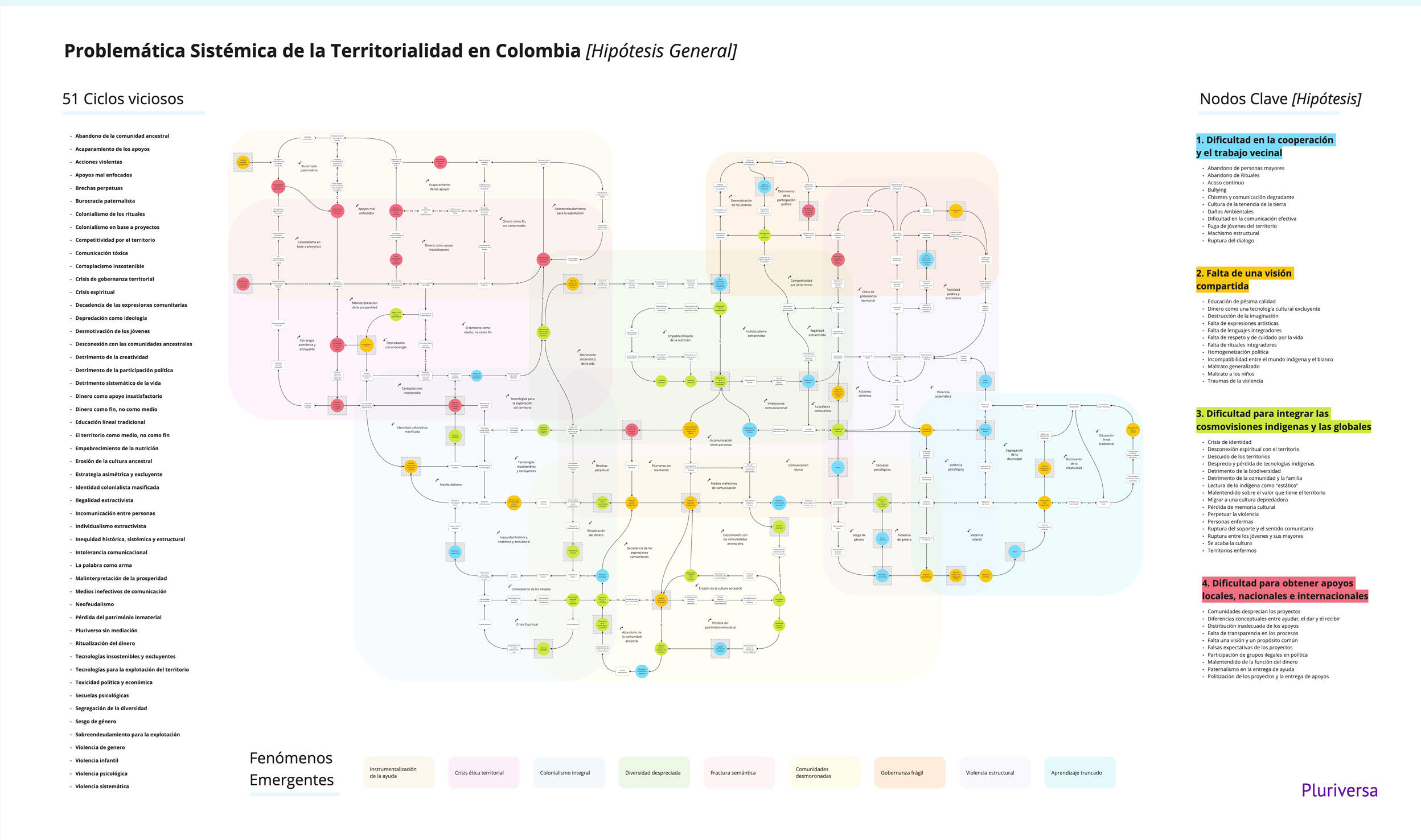
«Change in complex systems does not happen from a centralised place: it is the product of many concurrent processes, at multiple levels and in multiple domains at the same time.»
Systemic Problematique of Territoriality in Colombia
Pluriversa, 2022
Navigating complexity
Every element of the map tells something: the circular nodes are issues prioritised during the mapping, colours connect them to one of the four themes, and the vicious cycles are self-reinforcing chains of events looping through feedback.
The map’s central invitation is a question: how might we turn these vicious cycles into virtuous ones? Two guide videos accompany you to explore and co-create it.
51
vicious cycles
9
emerging phenomena
4
themes explored
2
guide videos
Four difficulties that reinforce each other
The themes that guided the research and analysis, from the people and from the strategy.
Lack of a shared vision
Without a common future that inspires every actor, each one pushes in a different direction.
Indigenous and global worldviews
Integrating profoundly different ways of seeing the world is hard — and it is exactly where the wealth lies.
Local, national and international support
Securing sustained backing at all three levels at once is an obstacle course for communities.
Neighbourly cooperation
Accumulated distrust makes cooperating with your neighbour, paradoxically, the hardest thing of all.
A map nobody owns
We published this hypothesis under an open licence (CC BY-SA) because systemic diagnosis is a common good: a closed map gets consumed, an open map gets co-created. Use it, validate it, correct it — and tell us what you found.
Let's talk about your territory
Systems mapping, co-creation facilitation and territorial dynamics reading to move from diagnosis to intervention. What comes next is designed by talking: 30 minutes, no slides, no commitment.