Our actions

Underhyped tech for post-development

A project to identify, imagine and activate nine pioneering technologies with high eco-social potential that currently go unnoticed.

Partners
Frontier Tech Hub, UK Foreign, Commonwealth & Development Office 

Year
2025

Services
Foresight · Innovation strategy · Applied research

This project redefines what deserves technological attention today. Instead of following the hype, we map and prioritise technologies with high social and ecological value that often go unnoticed. We combine evidence, scenarios for the future in 2035 and post-development criteria to arrive at nine underhyped technologies.
CHALLENGE

The global technological debate tends to focus on narratives of high hype and quick returns, leaving out technologies with great social, territorial and ecological value. The challenge was to identify these underhyped technologies and make strategic recommendations—based on foresight and evidence—so that public, private and community actors can explore, finance and adopt them fairly.

APPROACH

We combine research and technological curation with strategic foresight. To do this, we define technological selection criteria based on ‘attention’ (who is watching and why) and ‘potential’ (systemic and territorial impact).


With this approach, we studied 142 technologies with the potential to impact post-development at an international level.

IMPACT
  • Portfolio of nine undervalued technologies with eco-social significance.
  • Clear language for decision-makers: technological criteria and five sets of recommendations for financing and adoption.
  • Futures thinking to highlight risks and opportunities for 2035.
  • Post-development literacy and perspectives from the Global South towards technological solutions with greater territorial value.

What does ‘underhyped’ mean?

Our ‘underhyped’ technologies challenge dominant narratives of innovation. Despite their potential to strengthen community resilience, ecological balance, and locally-based solutions, they receive little attention because they do not fit into traditional funding models or challenge assumptions about ‘progress.’


We reframe attention (who is looking, why, who benefits) and potential (the capacity to create long-term systemic impact, based on local priorities) to value technologies that expand the realm of possibility.

The real frontier is not what is fashionable, but what can transform our lives in a sustainable way.
Not only are these technologies little known, but they also prove that a different form of development is possible, one based on ecological balance and community worldviews.

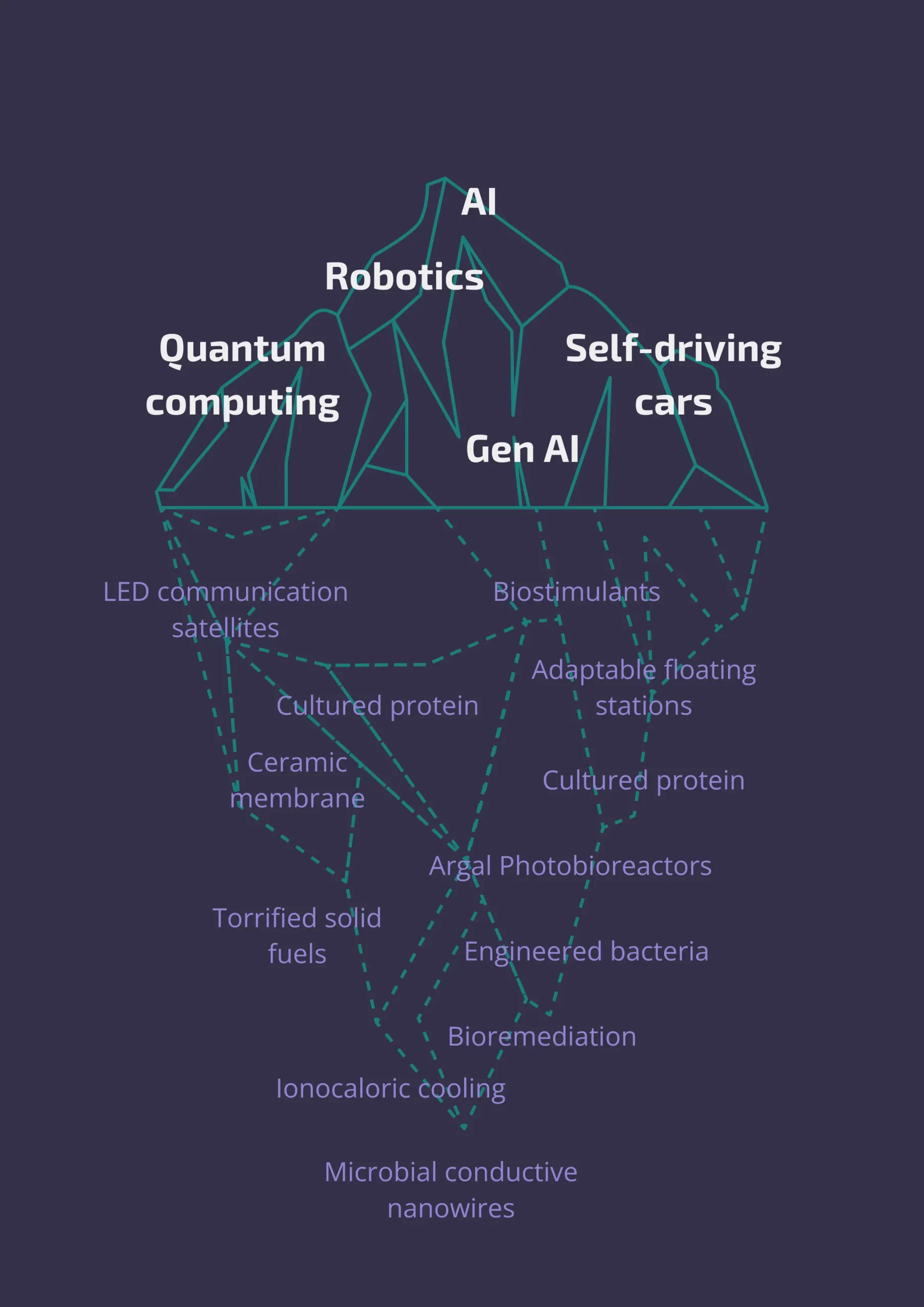
9 prioritised technologies

Click on the dots to explore the technologies.

Key recommendations

1) Data sovereignty and security

Move away from data extractivism and treat data as a common good. Communities decide what is collected, who has access to it and for what purpose, with decentralised infrastructure and security policies that prevent surveillance and misuse.

2) Community-centred economies and business models
Prevent technology from reproducing extractive dynamics. Promote local ownership and operation, circular economies and alternative finance that keep value in the territory.

3) Governance, social capabilities, and open technologies

Adoption depends less on the Technology Readiness Level and more on the social stack: bioregional governance, training, and community-controlled open source. It is about technological autonomy and peer learning.

4) Legal and ethical protection for implementation

Move from technology as private property to common good. Prevent monopolies, biopiracy and surveillance, and ensure human and environmental rights through proactive regulation and social participation.

5) Pluriversal research and community innovation ecosystems

Overcoming the ‘top-down’ approach. Researching and designing with communities, integrating indigenous, local and scientific knowledge, prioritising resilience, agroecology, water and restoration.

Exploring the potential of ‘underhyped frontier technologies’ requires a shift in how we approach technology itself, moving away from top-down models and towards community-driven pathways that focus on local knowledge, autonomy, and ecological regeneration.

How we did it

01

Curation and technological criteria

We explored a database of 142 technologies and filtered them by attention and potential with a post-developmental focus.

02

Expert validation

We compare with technical and territorial references to refine assumptions and biases.

03

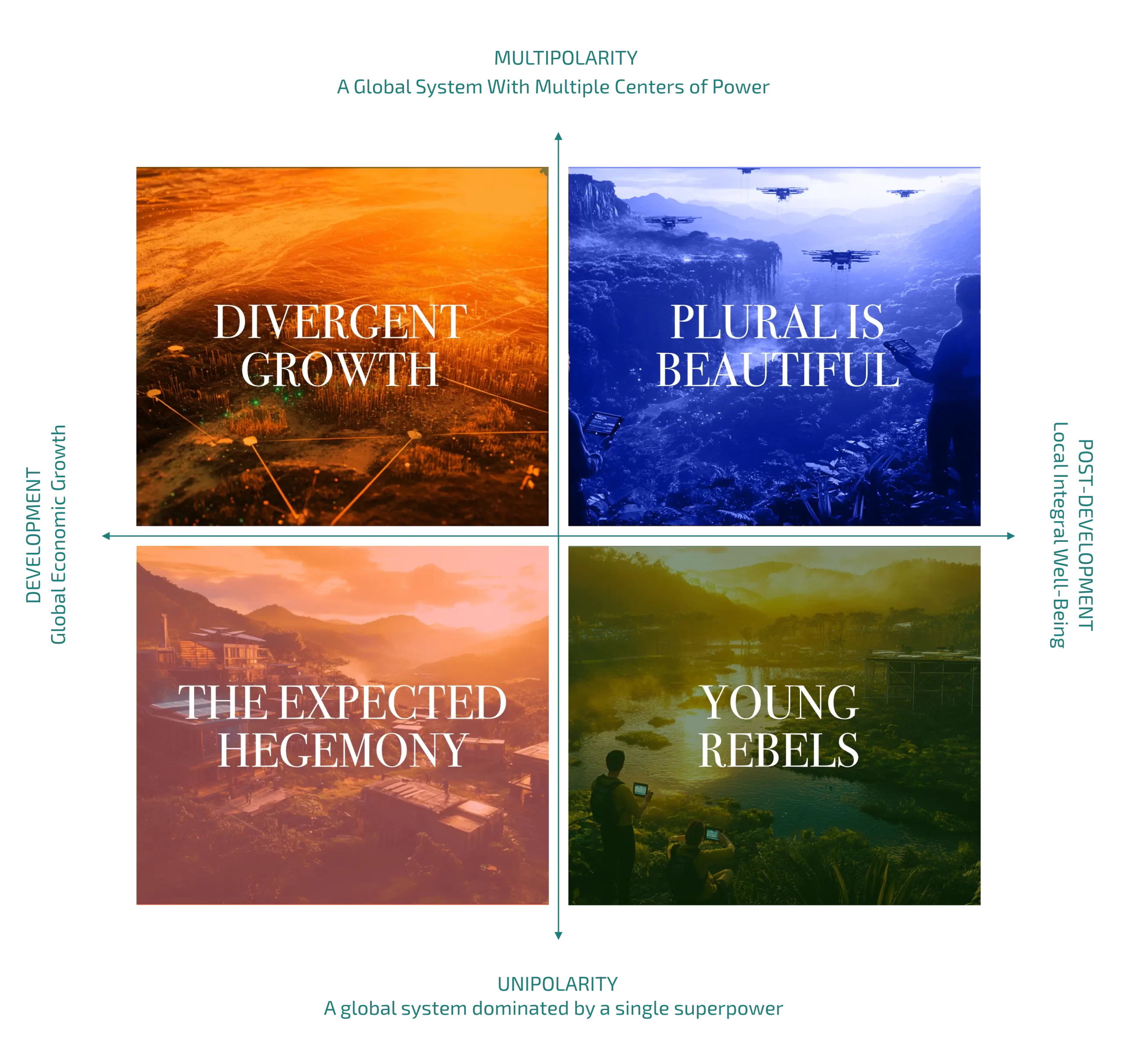
Scenarios 2035

We designed four scenarios that reveal plausible paths and critical risks.

04

Recommendations

Strategic and practical framework for integrating these technologies into international cooperation ecosystems.

Four scenarios 2035

Development ethos - VS - World polarity

01

Plural is Beautiful:

Bioregional governance and technology with community agency.

02

Young Rebels

Innovation from the margins; translocal cooperation and digital commons

03

Divergent Growth

Geo-economic competition; new dependencies via licences and data.

04

Expected Hegemony

Centralised deployments geared towards control; local autonomy at risk.

Simbolo med

“The technology that matters is the one that promotes autonomy and cares for life.”

— Pluriversa Team
This project means moving away from short-term interventions to facilitate long-term transitions, ensuring that decision-making power rests with local communities, and recognising that sustainable prosperity is inherently political.

Let's bring these techs to your territory

Discussions, workshops, and support for mapping systems, activating secure pilots, and setting up learning loops with our post-development approach.

Pluriversa team

This project was co-created by members of our Pluriversa Community:


Miguel Bello

Director


Ricardo Lapeira

Foresight & Ethics Lead


Daniela Montenegro

Design Researcher


Mauricio Franco

Researcher & Visual Designer

Juan Sebastián Sánchez

Strategic Designer


We would also like to extend our gratitude to our partners and teammates:

  • Dr. Becky Faith – FCDO
  • Asad Rahman – Brink
  • Bryony Nicholson -Brink
  • Lil Patuck – Brink
We work with people and organisations motivated by the positive impact on the Global South.