

CHAPTER 1
Supply Chain Disruption
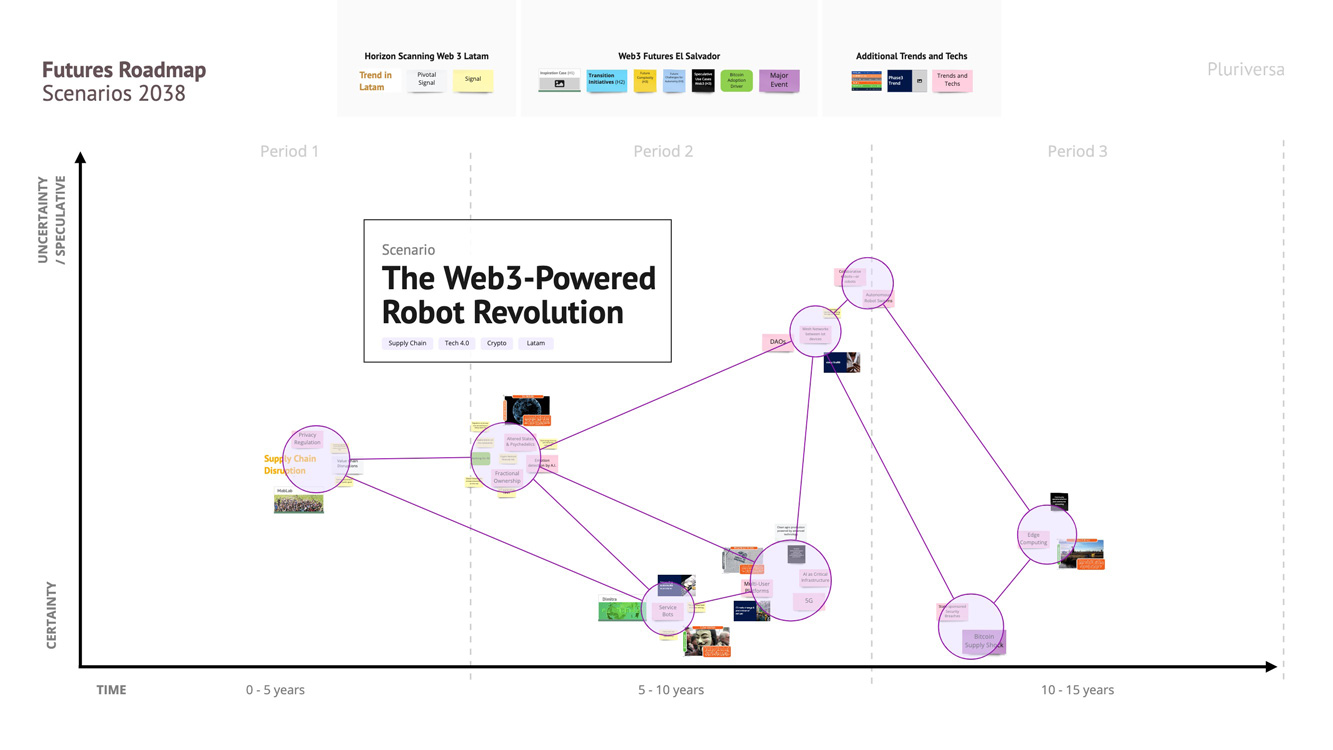
The year 2023 came to be remembered as “the great shortage” because of the supply chain disruption. As a consequence, 15 years later, countries had turned their external commerce policies, inverting their commercial balances and reestablishing important industries on their soil. The global economy figured out that certain strategic goods are best produced locally to avoid the risk of shortages in logistics supply chains. Globalization had been successful, but for many, it was necessary to rethink some aspects.
Developed countries saw an excellent opportunity to offer robotic and automation solutions to the global south. They gave them robots (hardware) and software so the robots could operate in a decentralized manner. This was all possible thanks to the risk aversion developed against the centralized models of Web2. In its place, Latin American countries hosted their data on a decentralized Web3 cloud. This cloud was censorship-resistant, and the distributed data system guaranteed that information would not be affected at a given point, making a server hack useless.
Latin America adopted these robot and automation technologies without giving them much thought in order to be able to produce locally certain strategic goods. This way, developed countries with a robotic industry were able to establish new commercial relations and consolidate a new form of economic power in the emergent market of robotic services, integrating multiple 4.0 technologies, like artificial intelligence, the Internet of Things (IoT), and, of course, Blockchain.
As on other occasions, the Latin American private sector was obliged to implement state-of-the-art technology in its logistical operations; otherwise, it would have had a disadvantage against external competitors. With time, Latin American tech talent specialized in developing Web3 software and the artificial intelligence used by robotic systems, converting software and artificial intelligence into two of the most important exports of the region.