


Our actions
Toolkit for the socioeconomic integration of migrants from Venezuela
Migration is not only a challenge: well supported, it is an opportunity for prosperity. With USAID — Opportunities Without Borders we designed 53 tools so the public, private, and financial sectors can move from good intentions to inclusive action.
Partners
USAID · Opportunities Without Borders · Chemonics
Year
2023 · Colombia
Services
Systemic research · Multi-stakeholder co-creation · Toolkit design

CHALLENGE
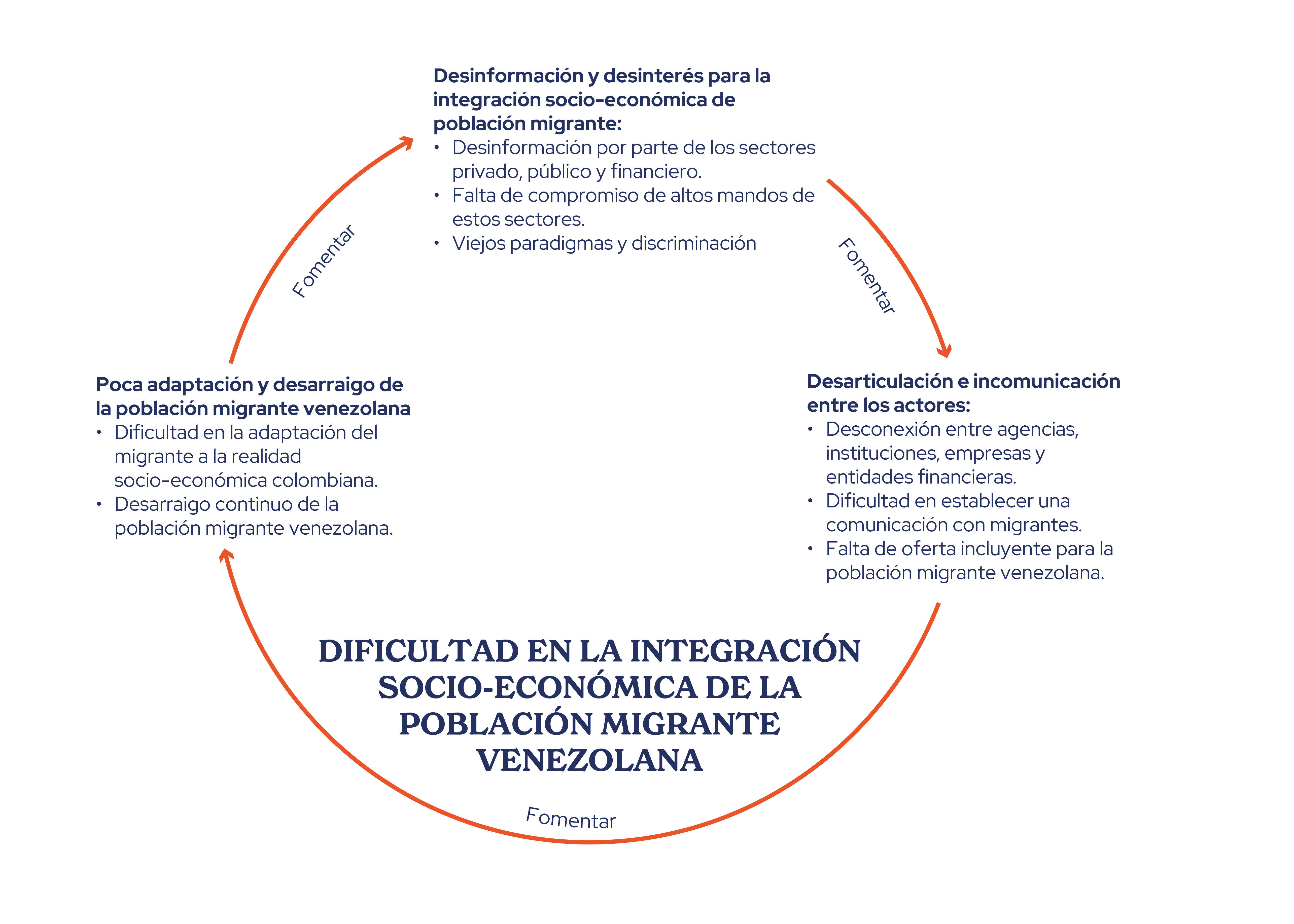
The socioeconomic integration of the migrant and returnee population from Venezuela is a systemic challenge. We found a vicious circle: labour, institutional, and financial barriers that reinforce one another and hold inclusion back.
APPROACH
With USAID — Opportunities Without Borders we co-created an action-oriented, organisation-focused toolkit, woven together with the voices of the three sectors, civil society, and the migrant population itself.
IMPACT
53 practical tools —workshops, checklists, canvases, timelines— that any organisation can adapt to move from intention to inclusive action.
The vicious circle that blocks integration
We listened to companies, public institutions, financial actors, social organisations, and the migrant population itself. A pattern emerged from that mapping: the barriers are not isolated —they feed one another—. Breaking the cycle means acting on several fronts at once.
A challenge of national scale

The migrant and returnee population from Venezuela is present across the whole of Colombia, most concentrated in the northern departments and the main cities. Integrating them is not a local matter: it is a national challenge.
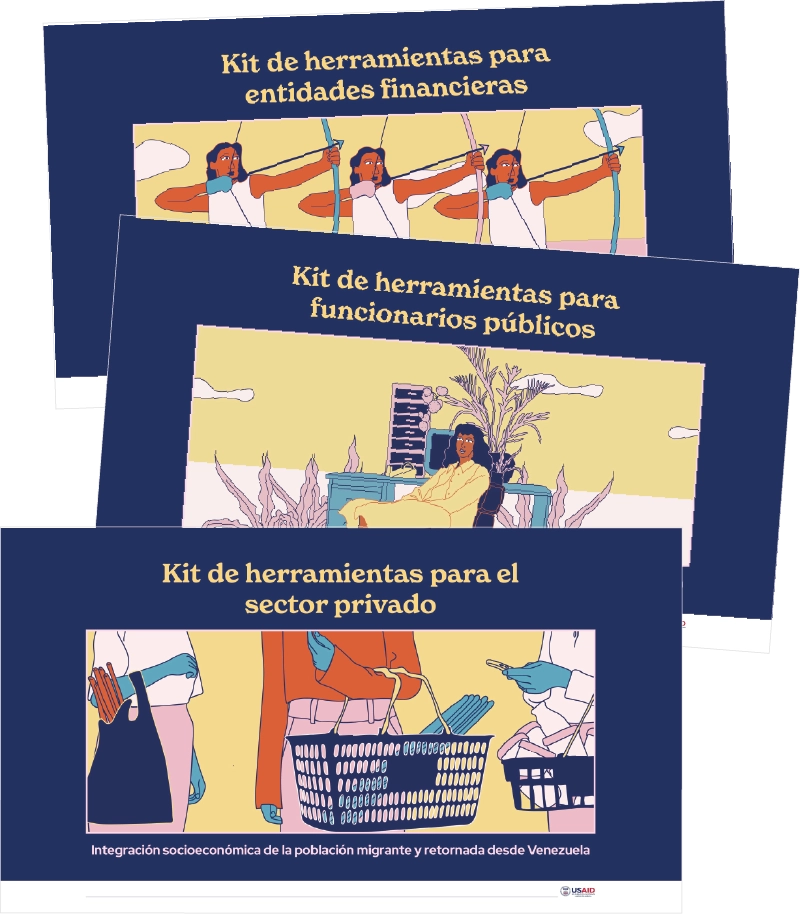
Who is this toolkit for?
It takes an organisational approach: it is designed for the teams that —from the private, financial, and public sectors, locally and nationally— decide and build more inclusive workplaces. Each sector has its own kit. Find your starting point:
If you are part of the private sector
and you are interested in promoting labor inclusion and entrepreneurship of migrants and returnees from Venezuela in your organization.
If you are part of the public sector
and are responsible for creating and implementing public policies and programs related to migration, and the socio-economic integration of the migrant population and returnees from Venezuela.
If you are part of the financial sector
and are looking for innovative ways to take advantage of the opportunities brought by the migration phenomenon in the country.
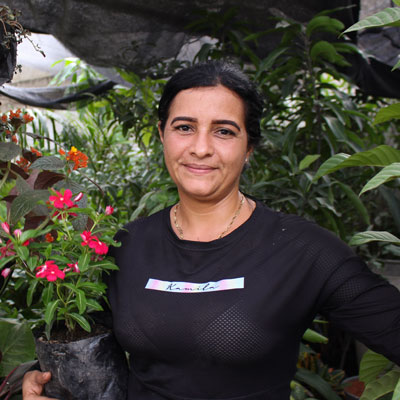
“Through my business I contribute to Colombia by employing vulnerable people and greening parts of La Guajira, and that makes me very happy.”
Anggy Lenny
Gardening advisor · Vivero 4 Rosas, Riohacha
What's inside the toolkit
Four chapters trace a journey —understand, include, activate, and connect— with 53 ready-to-use tools: workshops, canvases, checklists, timelines, and more, adaptable to your organisation.
01
Understanding
Characterises the migration situation: challenges, barriers, and opportunities in Colombia.
02
Including
Cultivates an inclusive, diverse organisational culture with a differential and gender lens.
03
Activating
Boosts employability and entrepreneurship, strengthening skills and opportunities.
04
Connecting
Links the sectors through a systemic lens to coordinate and act together.
1. Understanding
Provides an initial characterization and information on the migration situation, challenges, barriers and opportunities faced by the migrant population in Colombia.
🛠️ Apoya en la solicitud de refugio
▻ La migración como una oportunidad de inclusión y desarrollo
2. Including
It addresses tools for the development and promotion of an inclusive and diverse organizational culture with a differential and gender approach.
▻ Inclusión
🛠️ Rueda de la inclusión
🛠️ Forjando un equipo inclusivo
🛠️ Cronograma de estrategias para la integración socioeconómica de la población migrante y retornada desde Venezuela
🛠️ Diseño organizacional participativo
▻ Inclusión y equidad de género
🛠️ Inclusión en acción
🛠️ Abordando las barreras de género
▻ Estrategias de liderazgo para la inclusión laboral de población diferenciada
🛠️ Tips para la inclusión de población diferenciada
🛠️ Adaptaciones inclusivas
🛠️ Diversidad histórica
▻ Economía del cuidado
🛠️ Costos del cuidado
▻ Diferencias culturales y realidades personales
🛠️ Reta el prejuicio
🛠️ Ver más allá
🛠️ Venelingo - Diccionario de venezolanismos
▻ Violencias Basadas en Género (VBG)
🛠️ Más allá de lo evidente
🛠️ Escudo violeta
🛠️ Acción contra la indiferencia
🛠️ Protocolo de prevención y atención a VBG
3. Activating
Seeks to contribute to the employability and entrepreneurship of the migrant population in Colombia, with strategies and resources to enhance their skills and opportunities.
▻Trabajo decente
🛠️ Test de trabajo decente
🛠️ Test de inclusión organizacional
▻Empleabilidad y contratación equitativa de la población migrante y retornada desde Venezuela
🛠️ Camino hacia la empleabilidad
🛠️ Guía sobre documentación necesaria de la población migrante y retornada desde Venezuela para trabajar en Colombia
🛠️ Pasos a seguir para la contratación equitativa de la población migrante y retornada desde Venezuela
🛠️ Mapa de habilidades y conocimientos requeridos por las organizaciones
🛠️ Caracterización de habilidades y conocimientos de las personas migrantes - Ejemplo
🛠️ Mapa de habilidades, conocimientos y herramientas de las personas
🛠️ Describe puestos de trabajo
▻ Inclusión financiera
🛠️ Apoya al personal migrante en la inclusión financiera
🛠️ Entendiendo la banca comunitaria
🛠️ Grupos locales de ahorro y crédito (GLAC)
▻ Acompañamiento para el acceso y permanencia en el empleo
🛠️ Asegúrate de que estás haciendo acciones sin daño
🛠️ Proceso de inducción al nuevo personal migrante
🛠️ ProTalent
▻ Fomentando el Emprendimiento
🛠️ Emprendiendo en Mis Zapatos
🛠️ Tejiendo autonomía económica
4. Connecting
Its objective is to strengthen the connection between the sectors from a systemic and relational perspective for the coordination of efforts, favoring innovation and the formulation of concrete actions for integration.
▻ Más allá del enfoque lineal
🛠️ Mentalidad y postura
🛠️ El pensamiento reflexivo
▻ Oportunidades para la articulación
🛠️ Mapa de las partes involucradas
🛠️ Roles de los actores
🛠️ Valores compartidos
🛠️ Divergencia y Convergencia
🛠️ Estrategia de articulación
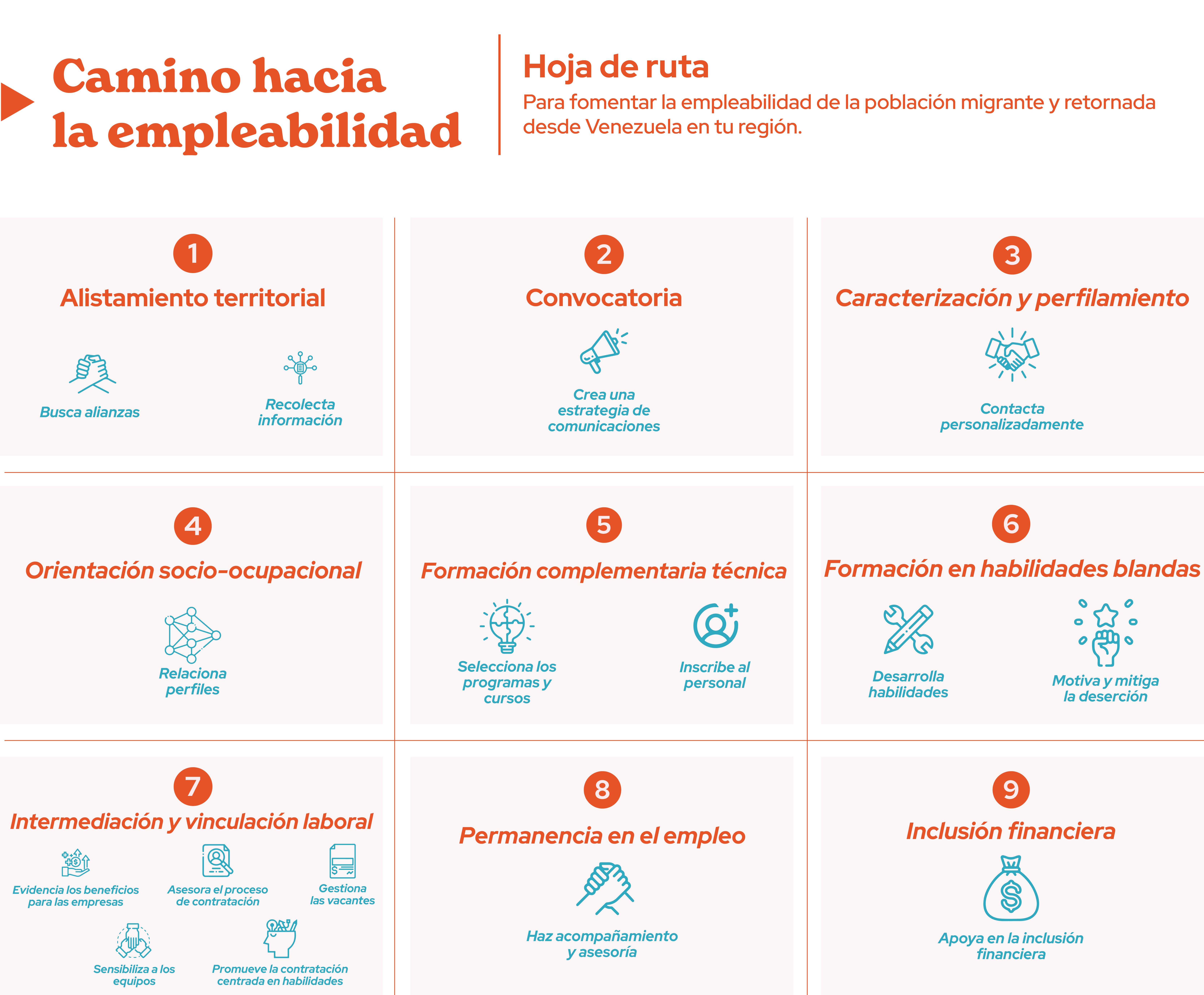
One tool, up close
This is what one of the 53 tools looks like: the Path to Employability roadmap, nine steps to bring the migrant population into work in your territory.
From intention to impact
Strengthening the public, private, and financial sectors is not a symbolic gesture: it is the condition for the inclusion of the migrant population to become real prosperity —social and economic— for Colombia.
Advance the inclusion of the migrant population in your organisation
Tools, workshops, and support so your team can move from intention to inclusive action. What comes next is designed through conversation: 30 minutes, no slides, no strings attached.