


Our actions
Powerful, clear, and streamlined governance for regeneration
Governance design for the Territorial Regeneration Fund: an operating pact, a decision-making mechanism based on consent and a protocol for working through tensions without slowing the network down, co-created with Colombia’s Territorial Foundations and TerritoriA.
Allies
Territorial Regeneration Fund · TerritoriA · Territorial Foundations
Year
2026 · Colombia
Services
Governance design · Legal design · Service design · Participatory design
CHALLENGE
A community philanthropy fund that was already moving resources into the territories needed rules to match its growth: a network of very diverse foundations, a custodian organization that carries the legal weight, and agreements that lived more in trust than on paper. The challenge: to design governance that protects the assets and the people without turning the network into a bureaucracy.
APPROACH
We listened to the organizations one by one, read the legal framework and drew up a legal and relational X-ray as a baseline. With it we created the Operating Pact, which starts from what already works and grows by milestones, not by calendar. We proposed a minimum base; we delivered full governance.
IMPACT
A Pact with five principles, six bodies and three pools; a roadmap in three cycles; a consent-based decision-making mechanism; a protocol for working through tensions in under 45 days; role handbooks; a Memorandum of Understanding signed by every organization in the Fund, and an AI agent for governance queries and to support the Fund’s day-to-day work.
From listening to the pact
First we opened up: listening to each organization and reading the legal framework. Then we closed in: an honest X-ray of the relationship and of the law. We opened up again: model options. And we closed with what the Fund can activate today.
1 · Discover
Listen and read
Listening dialogues with each organization in the Fund, a review of bylaws, minutes and agreements, and an analysis of the legal framework governing non-profit entities.
2 · Define
Legal and relational X-ray
The baseline that names what is valuable, the contractual gaps, the misaligned expectations and the unclear institutional boundaries. Discussed face to face in a co-creation workshop.
3 · Develop
From the minimum to the full model
We explored three desk models and tested them against the Fund. From there came the full model: bodies, mandates, cycles, funding pools and the protocol for tensions.
4 · Deliver
Learning by doing
Operating Pact, roadmap and role handbooks, tested in a learning-by-doing workshop. Closing with a Memorandum of Understanding for all the organizations.
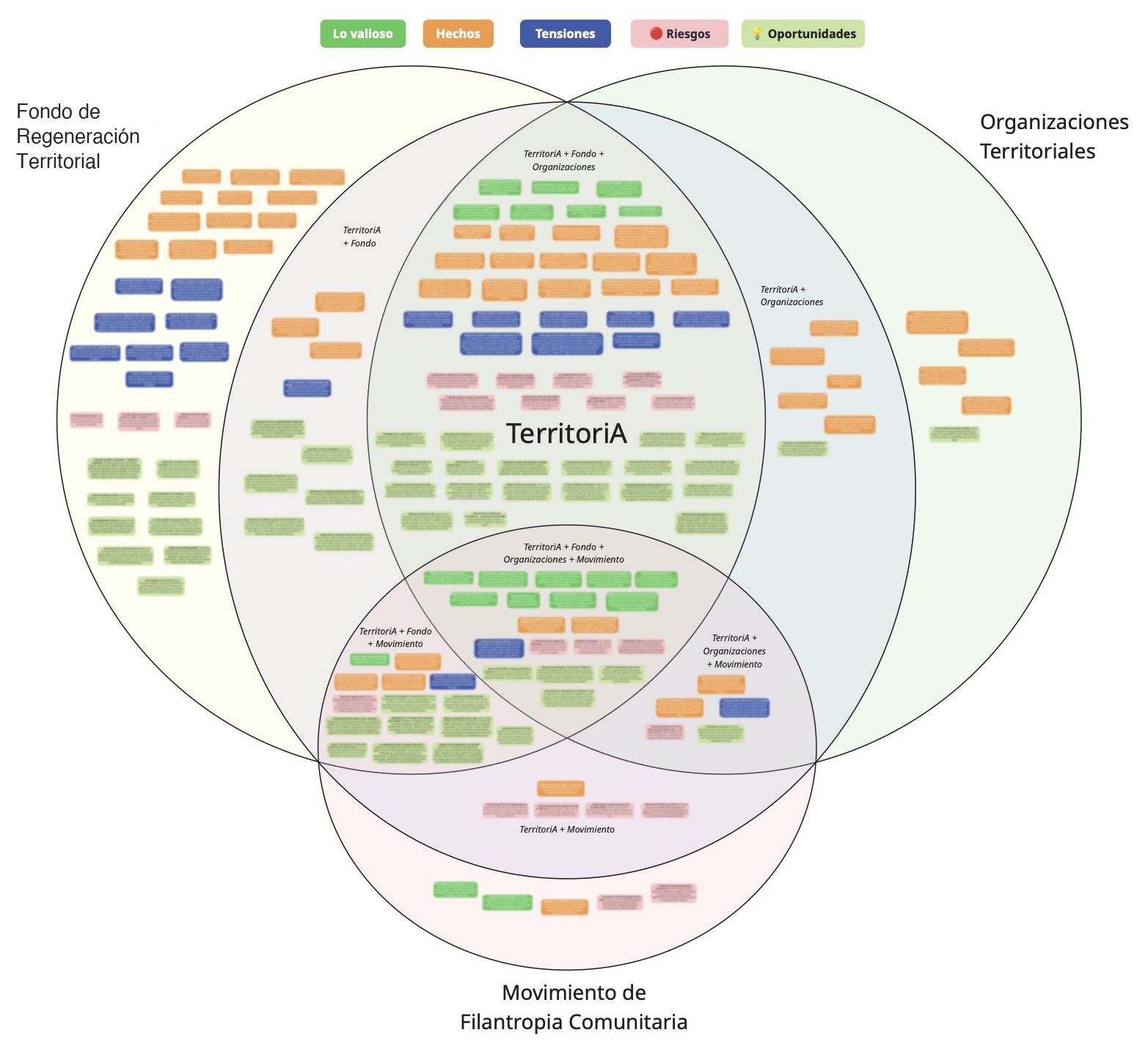
2 · Define
An honest X-ray before a single rule
Three overlapping circles: the Fund, the territorial organizations and the community philanthropy movement. At the center, where all three touch, TerritoriA. In each intersection we placed what we heard: what is valuable, the facts, the tensions, the risks and the opportunities.
It was the baseline we discussed face to face with all the organizations before designing a single rule. What each note says stays with the Fund: here we show the shape of the analysis, not its detail.
4
design moments
6
listening dialogues
2
co-creation workshops
7
signatory organizations
Three design practices behind the Pact
Valid governance is useless if nobody understands or uses it. For the Pact to be legal, understandable and something people could make their own, all at once, we crossed three practices that rarely sit at the same table.
Legal design
Rules you can understand without a lawyer at your side
Service design
The Fund as seen by those who use it
Participatory design
With the Fund, not for the Fund
The law as a bridge. Between the world of regulation and the living world of communities, legal design makes rules not only valid but something people can understand, own and use. That was the quality criterion for the whole process.
Five principles that order everything else
Before the rules, the principles. When a situation is not foreseen in the Pact, it is read from here. They are the compass for deciding what no set of regulations can fully describe.
Purpose guides resourcesMoney follows purpose, not the other way around: every resource is allocated according to its coherence with the regenerative portfolios and reaches whoever is best placed to deliver it.
Centralize the burden, decentralize the magicA single organization is custodian of legal compliance and treasury; creativity, execution and voice are distributed across the territories.
Promote diversity, recognize capacityBeing a mature or an emerging foundation is not a rank: it is a stage. Each one enters with rights and responsibilities to its measure and grows by meeting verifiable milestones, not by seniority or favor.
Co-responsibility and mutual careNobody decides alone on what affects everyone, and nobody carries the risk alone. The rules protect people as much as assets.
Safe enough to tryA decision is made when it is good enough for now and safe enough to try. You learn by doing, not by waiting for the perfect agreement.
“Centralize the burden, decentralize the magic.”
Guiding principle
Operating Pact · Territorial Regeneration Fund
Six bodies, a single purpose
The Fund was designed as an organism: each body has a verb, a mandate and a time band for responding. No body decides on everything. None acts alone.
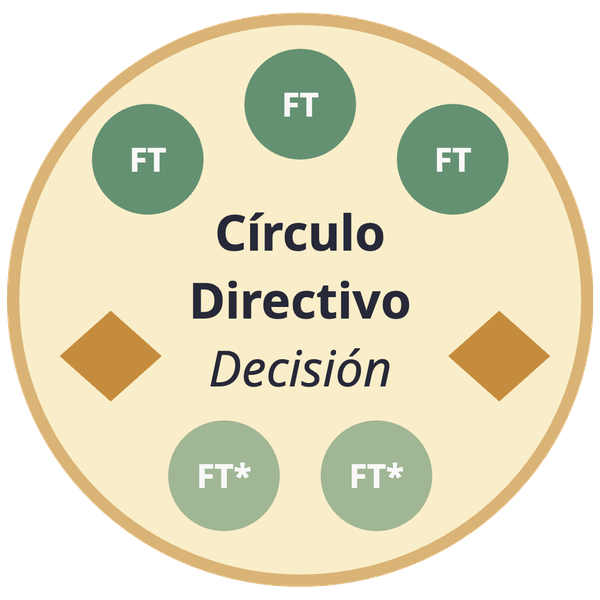
Decision
Steering Circle
Approves the strategy, the portfolios, the budget and changes to the Pact. It brings together the foundations and, from the second cycle, external advisors.
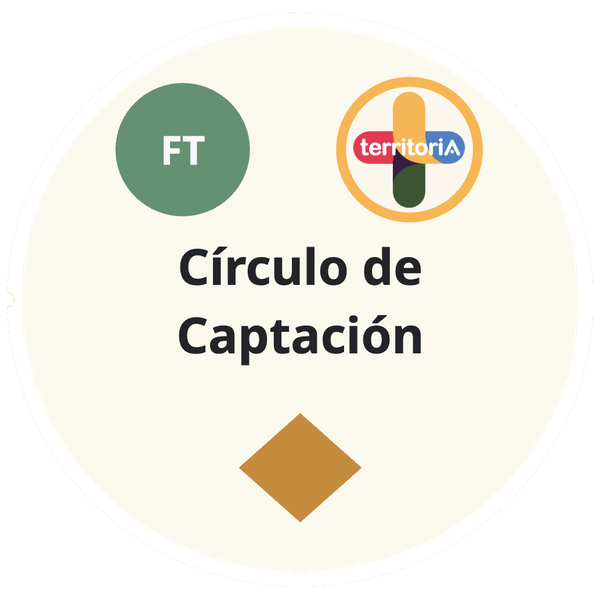
Fundraising
Fundraising Circle
Opens doors with allies and funders aligned with the purpose and brings in the resources, tagged by portfolio, with a clear mandate.

Preservation
Compliance and Treasury Custodian
Safeguards the assets, answers legally and executes transfers with more than one person verifying. It is the centralized burden.
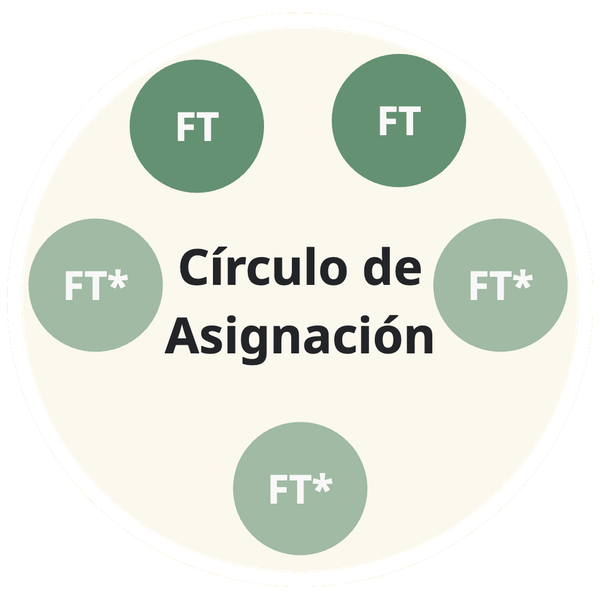
Allocation
Allocation Circle
Assesses the suitability of each proposal and chooses the most capable implementer: a foundation, an alliance or an external actor. Every allocation goes on record.
Management
Administrative Team
Convenes, documents and follows up. It is the Fund’s operational memory: minutes, logbooks, calendar and repository.
Mediation
Conflict Resolution Committee
Formed case by case, with a foundation not involved, an external mediator and the administrative team. It mediates; it does not judge.
Above them all, the Plenary: all the foundations gathered every six months to evaluate, renew mandates and ratify what nobody else can decide. With voice and vote.
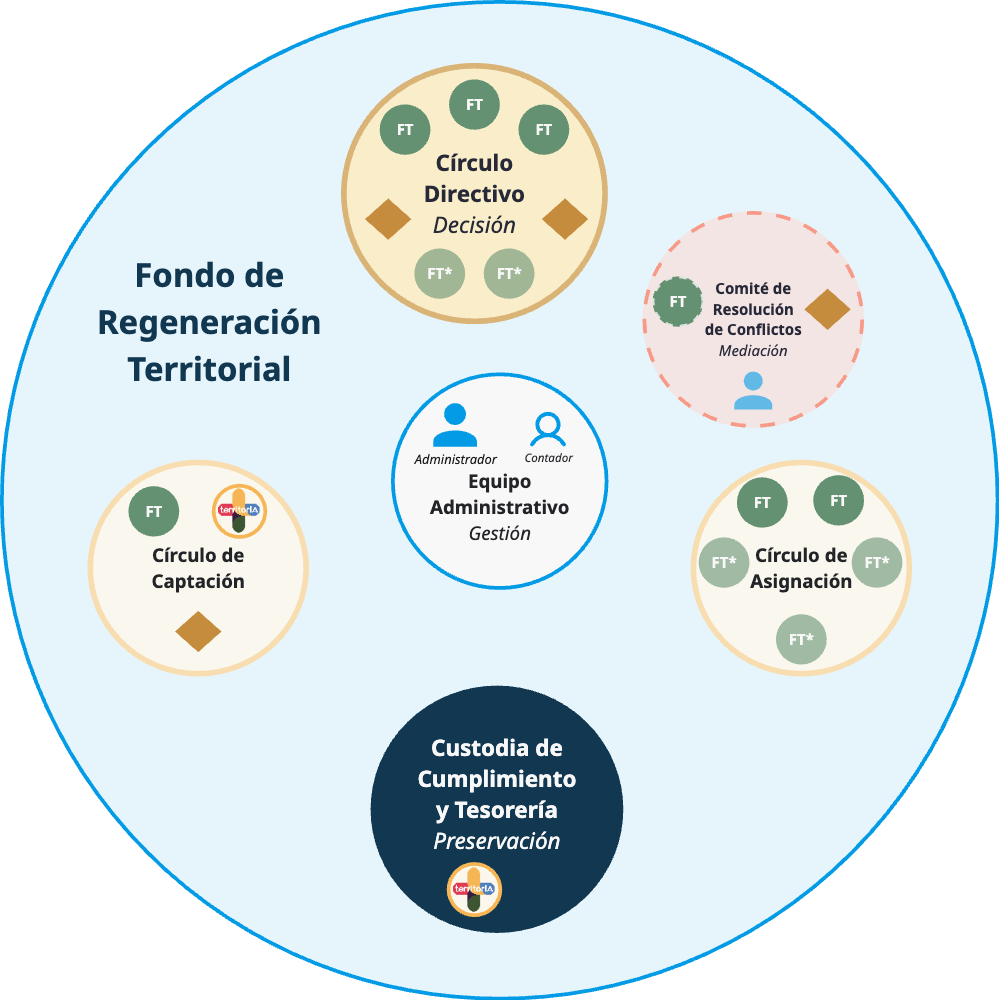
This is what the Fund looks like in its third cycle
A single diagram so that any member, new or long-standing, understands where they stand: the bodies inside the Fund, the money held in three pools, the four portfolios through which it enters and flows, and outside, the two networks that sustain it.
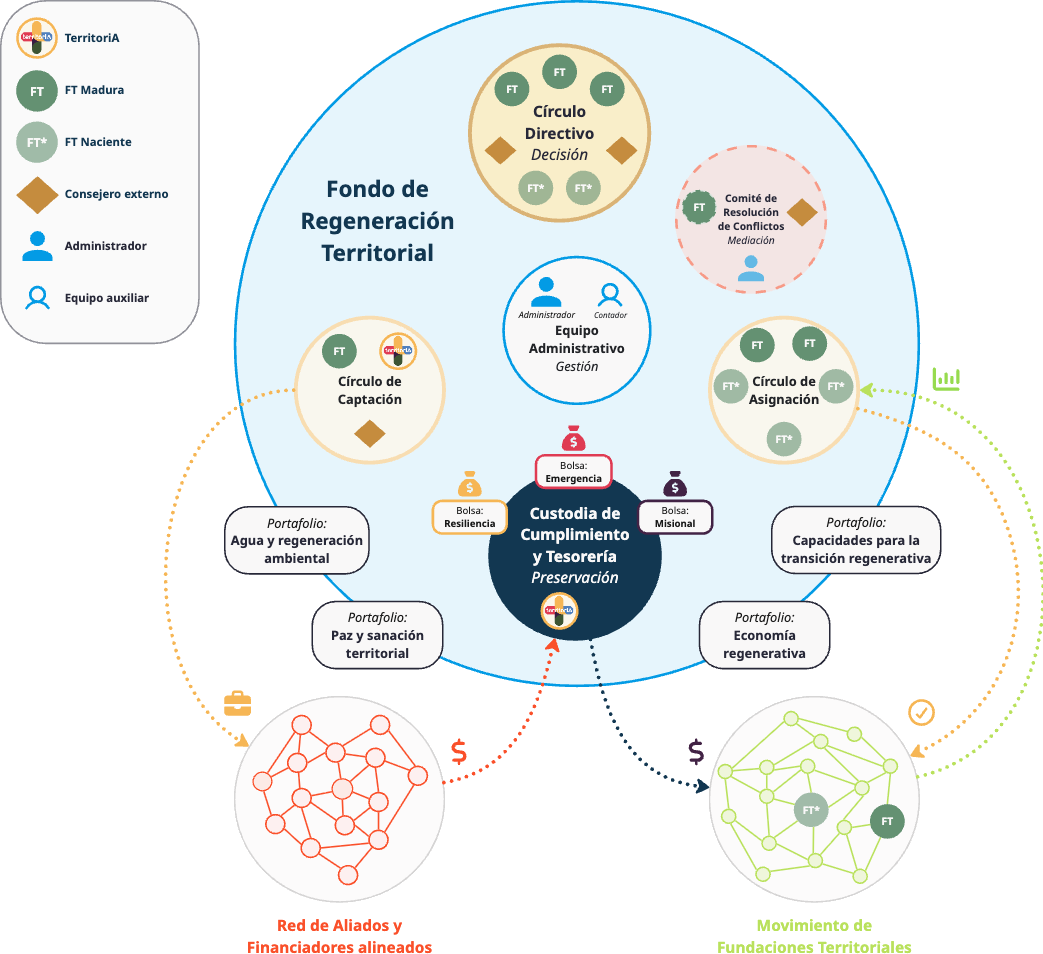
Diagram of the Fund in its expansion cycle: six bodies, three pools, four portfolios and, outside, the network of allies and funders and the territorial foundations movement.
Three pools, one custodian
The money is not mixed: each income is split between three pools with their own activation rules, and each pool answers a different question.
Resilience
Sustains the foundations’ operations and recognizes the roles that make the Fund work. It is the oxygen of the network.
Emergency
A capped reserve for the unforeseeable and serious. It is activated without waiting for a session, with evidence and five criteria that must all be met at once.
Mission
The largest of the three, with a guaranteed minimum floor. It funds the projects of the four regenerative portfolios.
Four regenerative portfolios
The portfolios are both fundraising fronts and allocation routes: tagged money comes in through them and flows through them to the territories. Funding projects that reinforce each other, not isolated initiatives.
Environmental regeneration
Regenerative economy
Regenerative education
Regenerative culture and territorial healing
It grows by milestones, not by calendar
The Pact does not start with every body active. It unfolds in three cycles, and the move from one to the next is triggered by milestones met, not by dates. If a milestone is lost, the Fund goes back to the previous cycle without drama.
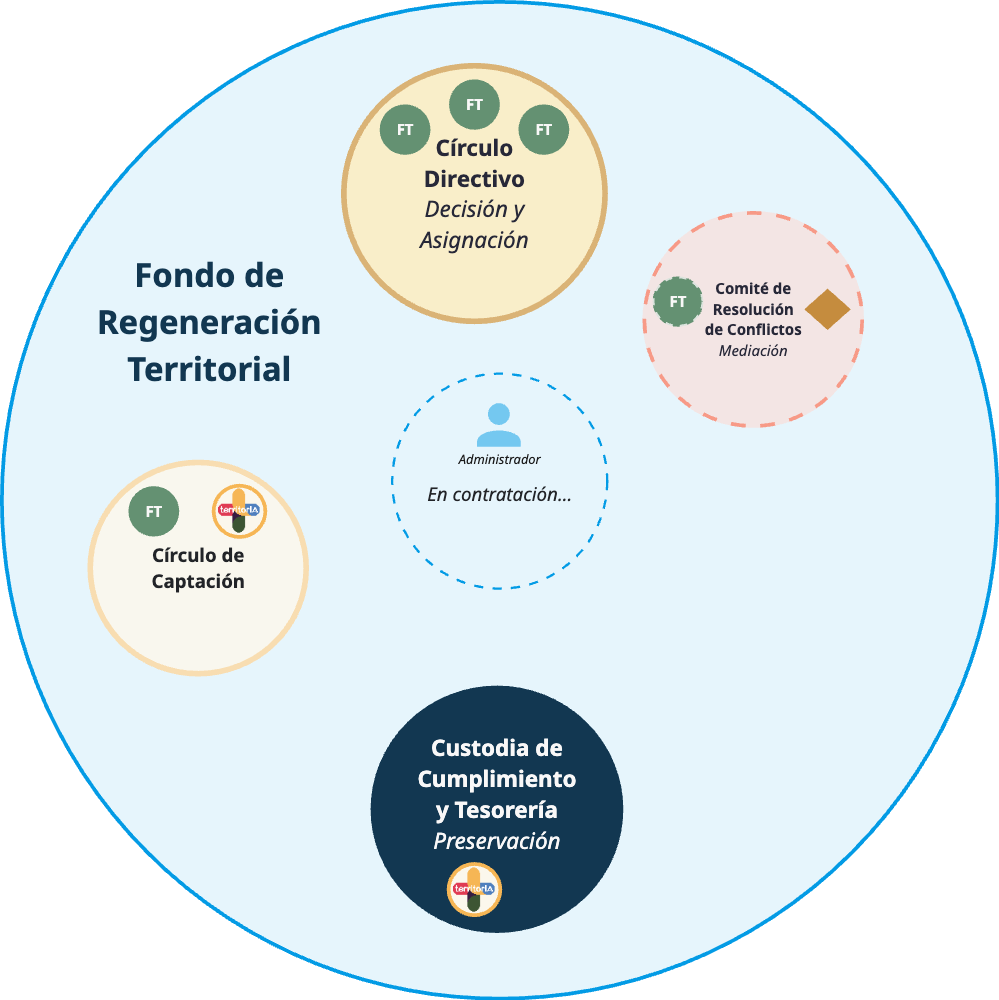
Cycle 1
Stabilization
Vital signs first: protected assets, minimum roles and traceable decisions. Few hands, much clarity.
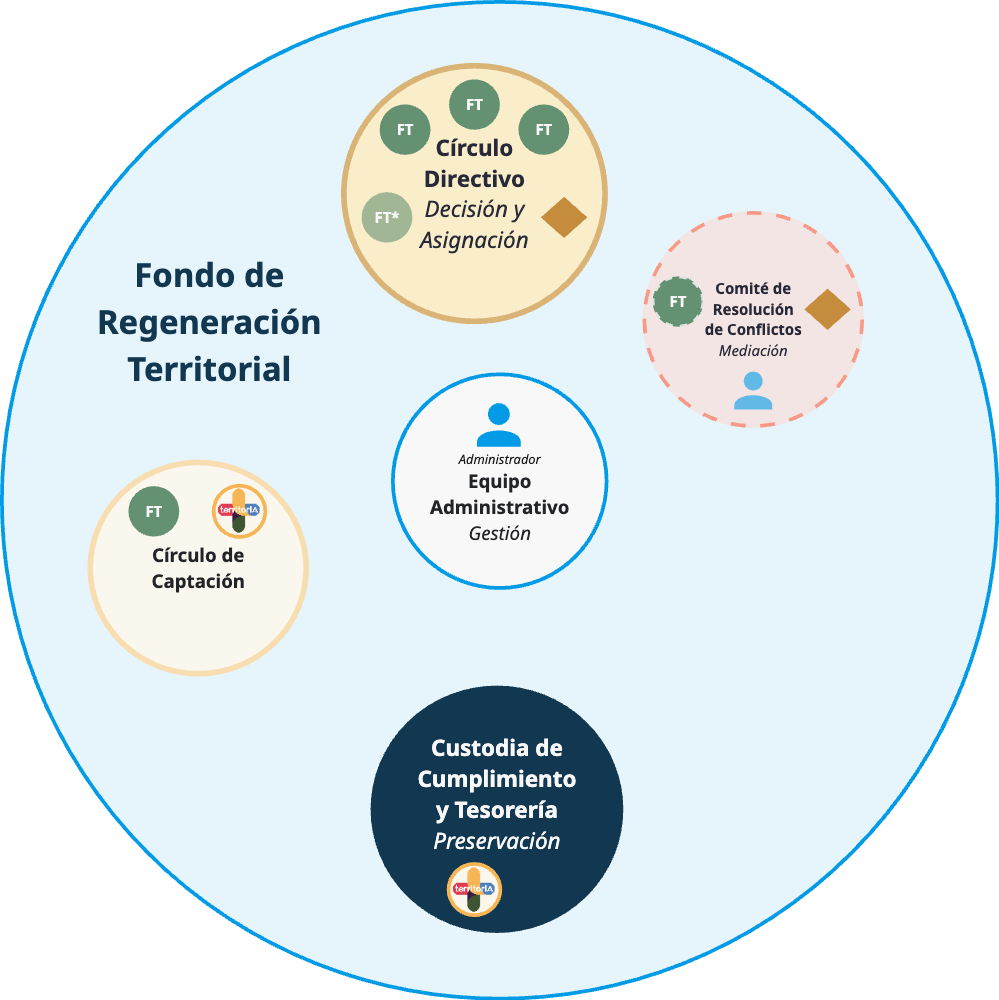
Cycle 2
Alignment
The organism starts to work: the circles open, roles are tested and the administrative team is activated.
Cycle 3
Expansion
Every body active, the portfolios under way and fundraising open to new allies. It grows on firm ground.
Start-up clause. When a body or a role does not exist yet, its simplest equivalent applies. Nothing stops for lack of structure: the Fund operates from day one with what it has, and adds pieces as it matures.
Deciding by consent
Neither absolute consensus that paralyzes, nor a majority that leaves people wounded. A proposal is approved when nobody has a valid objection, and every objection becomes an improvement. Consenting is not loving the proposal: it is being able to live with it.
Six steps, one session
- PresentThe proposer lays out the proposal and the problem it solves.
- ClarifyQuestions to understand, not to give opinions.
- ListenA round of reactions: every voice, once.
- ImproveThe improvements that make the proposal safer are integrated.
- ApproveApproved unless there is a valid objection. If it persists, a neutral third party assesses it.
- RecordEvery decision goes into the minutes: what, who, when and under what conditions.
Time bands for responding
Work through tensions, don't pile them up
A protocol so that tensions turn into learning rather than fractures. Six stages, a cap of 45 working days and a golden rule: deadlines are ceilings, not waiting times.
- AlertAny member writes down what they see. Notifying is not escalating.
- CommitteeFormed for the case, with no involved parties on it.
- DiagnosisWhat is at stake, what kind it is, how urgent and at what level.
- Talk or mediateFirst between the parties; if that is not enough, with mediation.
- OpinionThe Committee proposes a way out and its conditions.
- DecisionThe Steering Circle decides by consent and it goes on record.
⛏️OperationalDeadlines, deliverables, processes and resources. Resolved by adjusting the how.
💔RelationalTrust, communication and who speaks for whom. Resolved by talking, with care.
⚖️LegalCompliance, assets and obligations. Resolved through verification, not mediation.
Four questions sort out any case
- What is at stake?
- What kind of tension is it?
- How urgent is it?
- At what level: between organizations, between people or with an external actor?
Conflicts have a name attached. There are no anonymous channels: whoever raises the alert signs it.
The person is not the organization. A tension between people does not make their foundation a party to it.
Stepping someone aside as a precaution is not a sanction. Protecting the process while things are clarified is not a punishment.
A dignified exit. Whoever decides to leave does so with clear rules, timelines and no reprisals.
Rules that protect without smothering
Few rules, but firm ones. Each closes a door through which the problems of collective funds usually enter, without taking the air out of the operation.
Double keyChanges that touch the Fund’s backbone are decided in two steps: the Steering Circle consents, the Plenary ratifies.
Red linesConduct that is not mediated: it freezes resources on the spot and goes straight to the final decision.
Membership by milestonesJoining the Fund is a path of milestones, not a signature. Leaving also has rules and dignity.
Speaking with a mandateTalking about the Fund is free. Speaking on behalf of the Fund requires a written mandate.
TraceabilityEvery decision and every transfer leaves a trace: minutes, supporting documents, date and person responsible.
Legal capsCustody fee and costs with a ceiling, aligned with the tax regime for non-profit entities.
What stayed in the Fund's hands
Clear documents, kept within reach, that can be consulted in minutes and practiced from day one. Everything the Fund needs to operate was written, drawn and tested with its members.
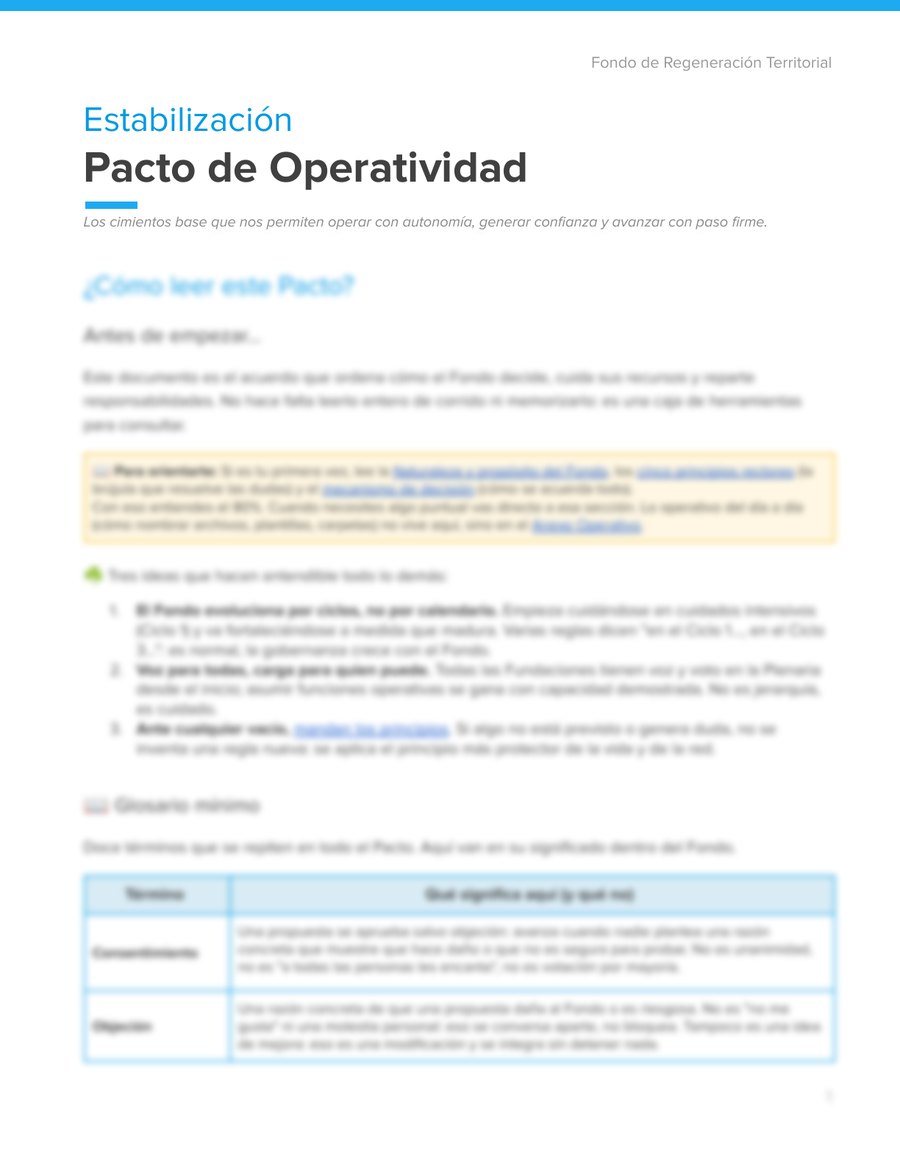
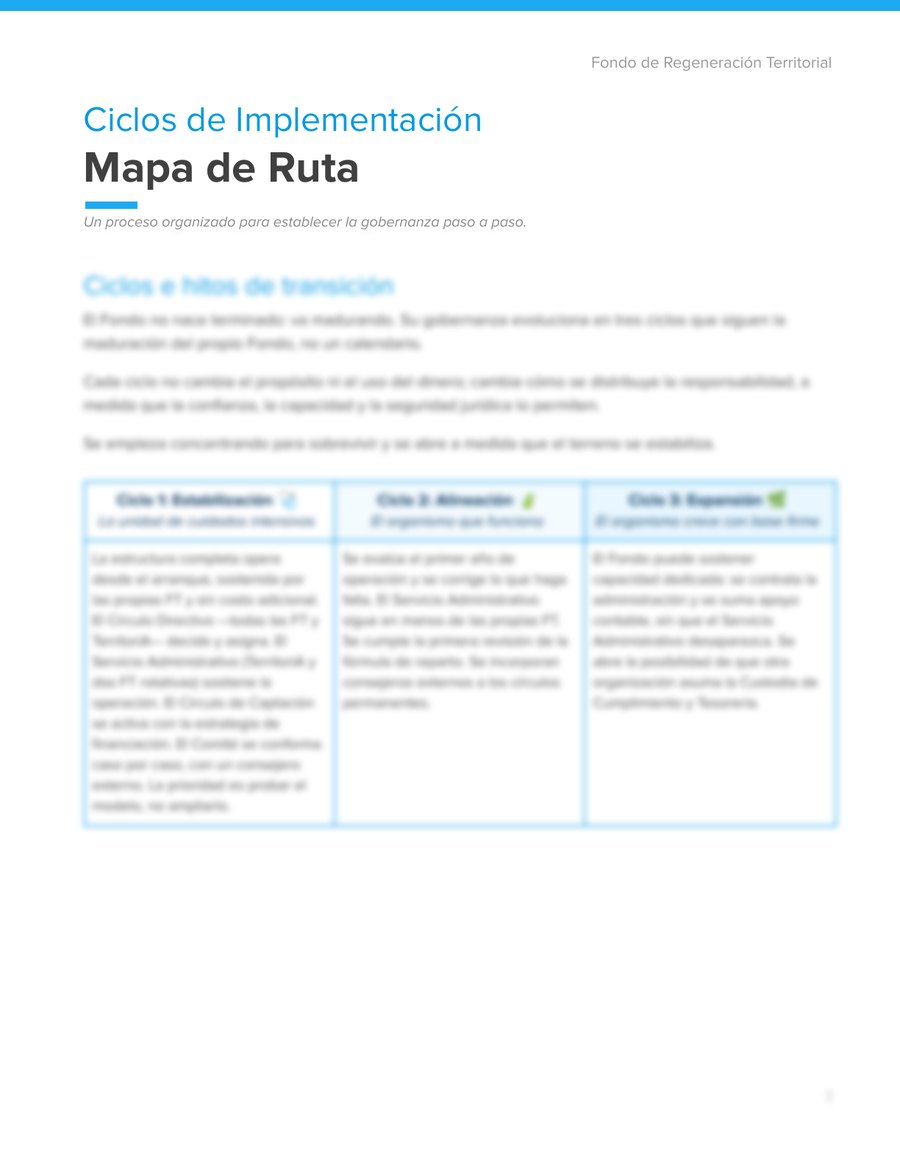
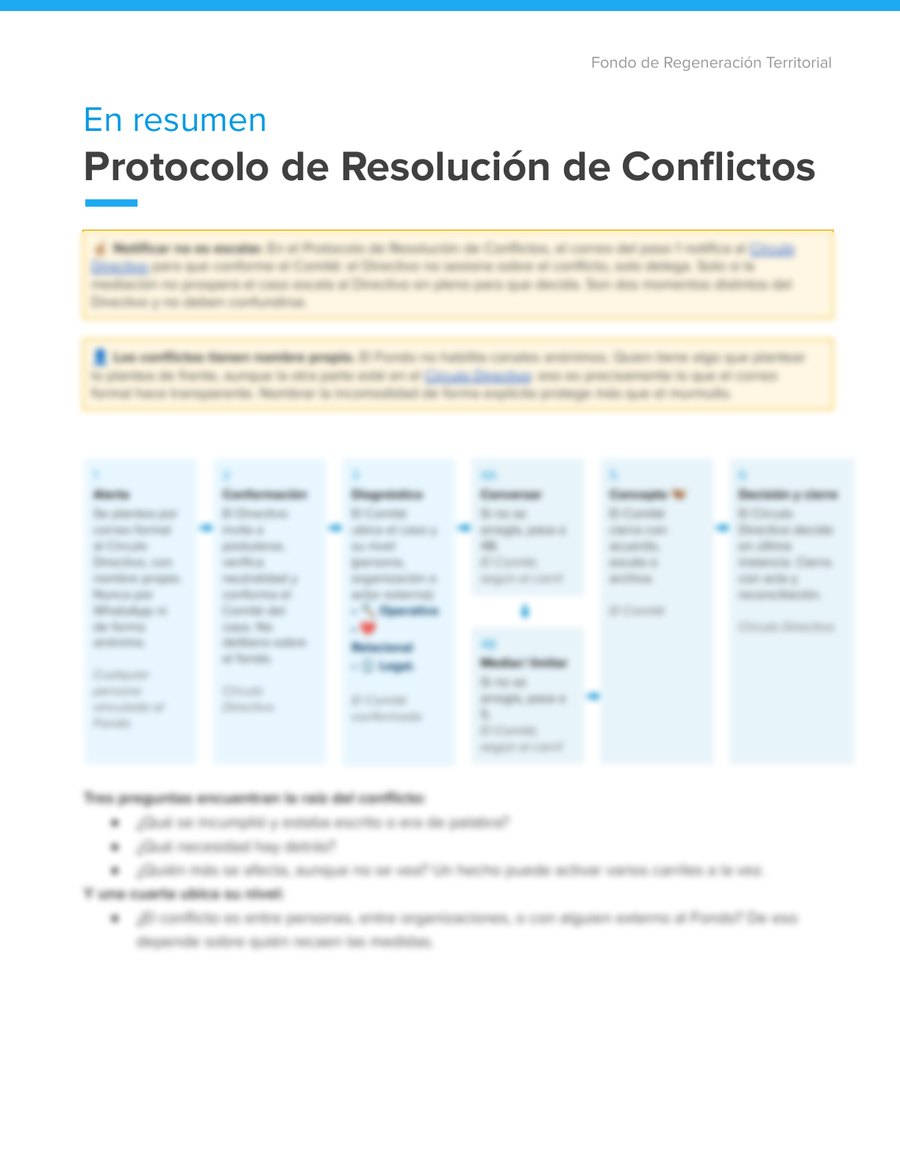
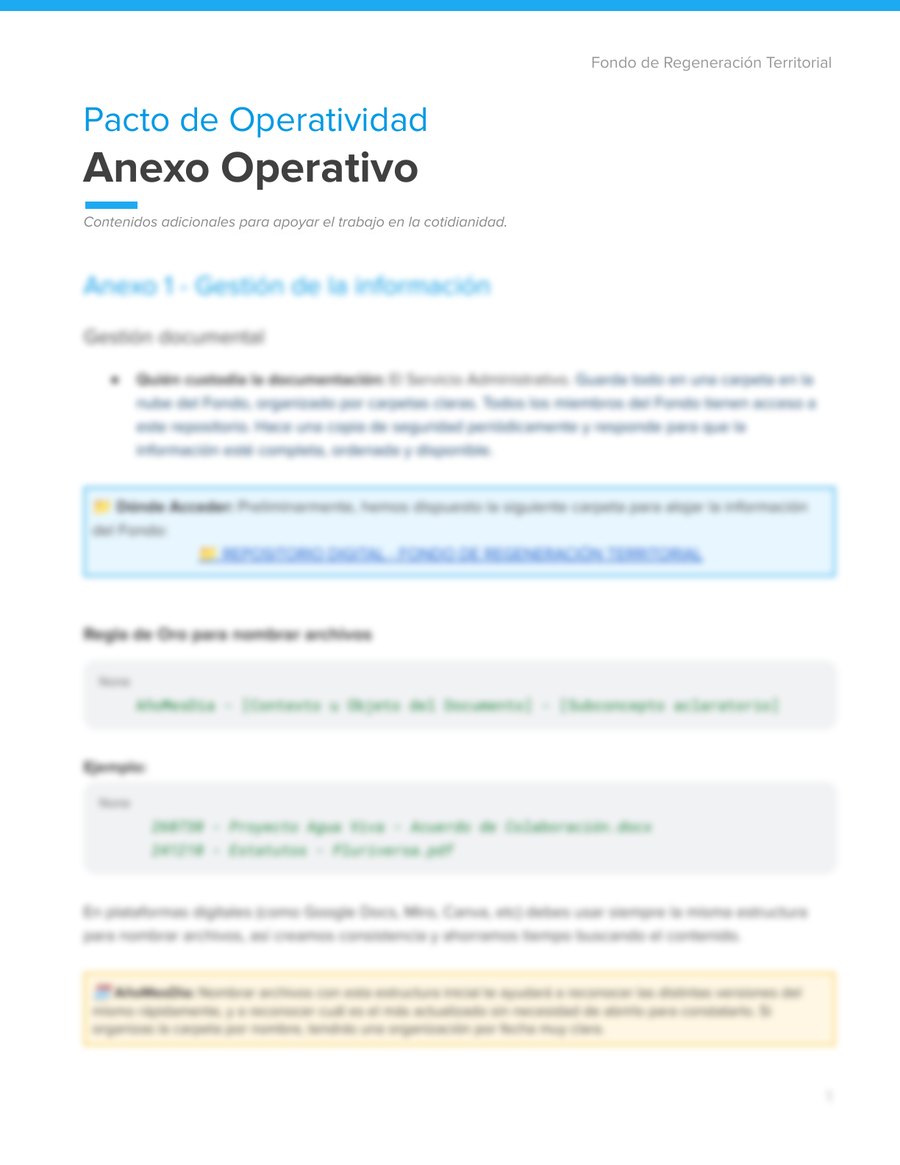
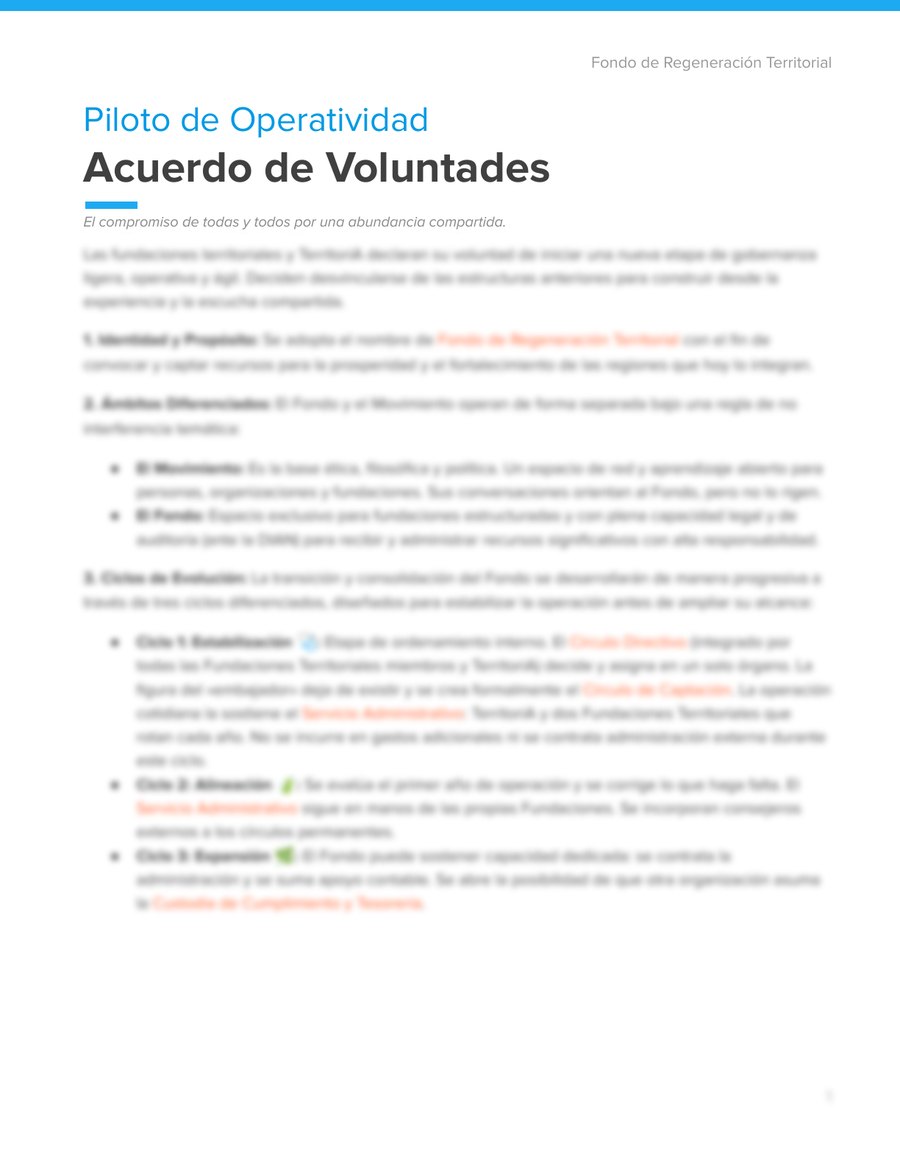
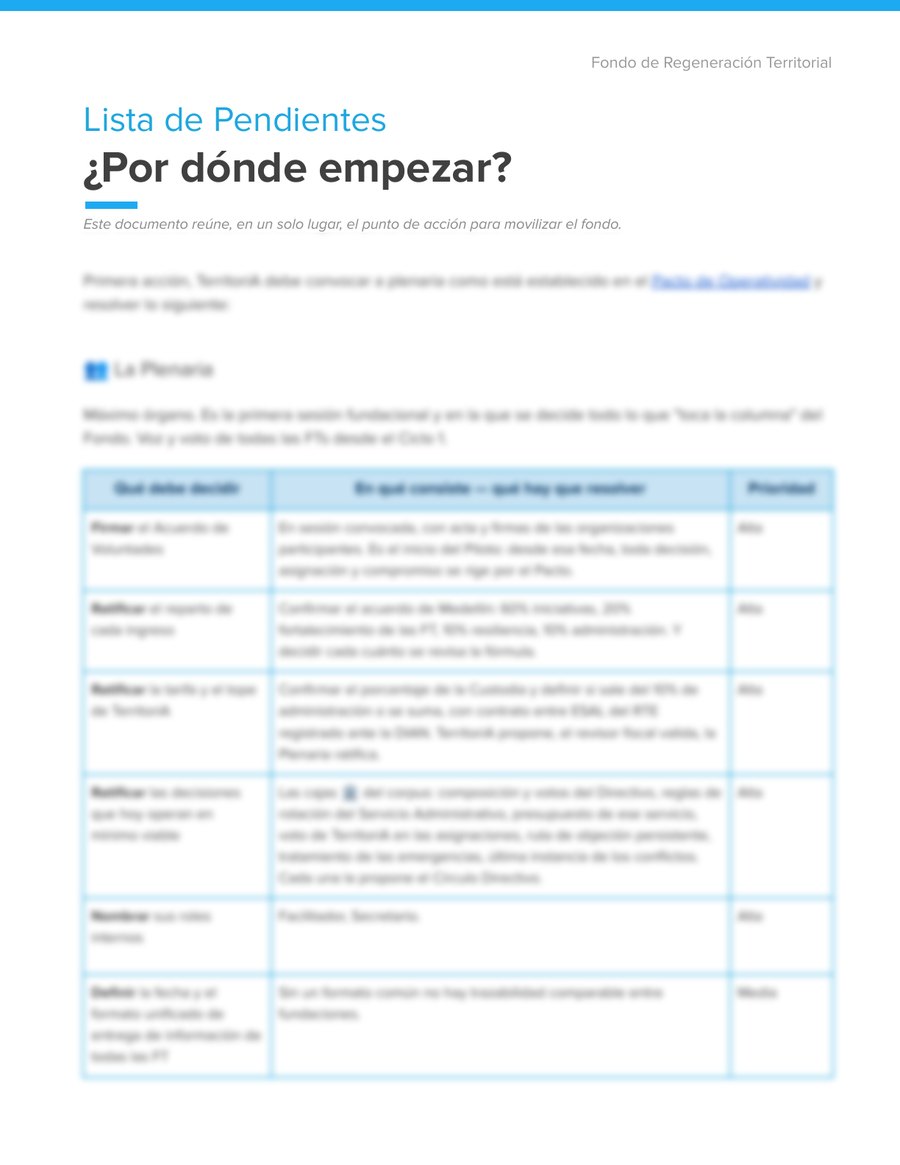
Operating Pact, roadmap, conflict resolution protocol, operating annex, Memorandum of Understanding and a guide on where to start. We show the covers; the content stays with the Fund.
Operating PactBodies, mandates, cycles, pools and decision-making mechanism in one short, actionable document.
RoadmapThe milestones that activate each cycle, by axis: legal certainty, coordination and maturity.
Tensions protocolStages, lanes, questions and timelines for working through conflicts without improvising.
Operating annexProgress and impact indicators by portfolio, alerts and safeguards.
Role handbooksWhat each one is responsible for, on a single page: mature foundation, emerging foundation and custodian organization.
Memorandum of UnderstandingEach organization’s commitments to the Fund’s new stage, signed by all.
Digital repositoryTemplates for minutes and logbooks per body, and the Fund’s single shared folder.
AI agentTrained on the Fund’s documentation: it answers governance questions and supports day-to-day work.
Governance is not written: it is practiced
A governance model is worth the decisions it allows people to make the following Monday. We set out to design the minimum viable base and ended up delivering the full governance: enough rules to operate safely, a mechanism to learn from every tension and handbooks so that everyone knows what is theirs to do. It was our contribution to their regeneration effort. What follows, the Fund writes cycle by cycle, with its own hands.
Pluriversa team
We accompanied this process from our Pluriversa Community, working in Colombia with the Fund’s organizations:

María Posada
Systemic and environmental lawyer
Miguel Bello
Director
Let's design the governance of your fund or network
Governance models, decision-making mechanisms and protocols for working through tensions in funds, networks and multi-stakeholder alliances. No recipes, just method. What comes next is designed in conversation: 30 minutes, no slides, no strings attached.